The companies that raise capital are not necessarily the best ones. They are the best-prepared — the ones whose data can be trusted.
The Position
Investors don't fund businesses. They fund data they can trust.
That sentence sounds blunt, even unfair. Most SME owners have spent years building something real — real customers, real revenue, real teams. The idea that an investor's decision turns on a spreadsheet, not on the substance of the company, feels reductive. It feels like the system rewarding paperwork over performance.
It isn't. It is the system protecting itself from risk. And once that becomes visible, the way an SME owner thinks about fundraising has to change.
Every transaction that involves capital is, at its core, a transfer of trust. The investor is being asked to believe that the future earnings of the business will justify the price being paid today. Nothing in that sentence depends on the founder's effort or character. It depends on whether the data describing the business can be trusted to predict the future. When the data is structured, that trust can be transferred. When the data is unstructured, it cannot — no matter how good the business actually is. The transaction either passes the data test or it does not.
The Problem Most SMEs Run Into
Across Southeast Asia, the failure rate at fundraising is not a small number. It is 97 percent. Ninety-seven out of every hundred SMEs who attempt to raise capital walk away without it. The natural assumption is that those businesses must be the weak ones — under-performing, undifferentiated, not investable.
The data tells a different story. Most of those businesses are operationally fine. Many are growing. Some are profitable. A meaningful share of them are better-run than the companies that succeeded in raising. They are not failing because the business is bad. They are failing because the data telling the business's story is unstructured, incomplete, or impossible for an outsider to verify quickly.
That is the gap. And until it is named correctly, no amount of pitching practice, networking, or revenue growth will close it.
Investors fund what they can verify. They cannot verify effort. They cannot verify hope.
— Pillar 1: Data Before Capital
The Reframe
The standard advice given to SME owners trying to raise — build relationships earlier, refine your pitch deck, hit a higher revenue band first — all sits on top of an assumption that the investor is evaluating the business itself. That assumption is wrong.
An investor evaluating a business does not have time to understand it the way the founder does. They have a portfolio to manage, a thesis to test against dozens of deals, and a fiduciary duty to their own capital providers. What they are actually evaluating is whether the data in front of them is structured well enough that they can form a defensible view in the time they have. If the data is clean, the business gets a real conversation. If the data is messy, the business gets a polite decline — and the founder is left guessing why.
This is not a flaw in how investors work. It is the rational response to information asymmetry. Investors fund what they can verify. They cannot verify effort. They cannot verify hope. They can verify structured numbers, documented processes, and a growth model whose assumptions are visible.
The same asymmetry runs the other way too. The investor does not know the founder. The founder does not know which of a dozen potential investors will actually move. Both sides are operating with incomplete information about each other, and both sides are looking for the same signal — a reason to spend the next hour of time, then the next month, then the next eighteen months together. Structured data is that signal. It is not a substitute for the relationship; it is the precondition for the relationship to be worth starting.
That is the reframe. The business is not what is being assessed. The data about the business is.
The System That Closes the Gap
Capital readiness is a structured output, not a personality trait of the business. A company becomes capital-ready the moment its data is organised the way an investor needs to read it — and not a moment before. That structuring is what BizPal calls the Data Room.
The Data Room is the work that comes before the pitch — verifying financials, structuring the business model, putting governance foundations in place. The point of it is simple: what an investor sees in the first ten minutes should line up with what is true inside the business. When those two pictures match, the business is capital-ready. When they don't, no amount of polish on the pitch deck will close the gap.
The reason most SMEs skip this stage is that it feels invisible. There is no customer to win, no product to ship, no campaign to run. It looks like documentation work. From the inside, it can feel like a tax on the real work of running the company. From the outside — from where an investor is sitting — it is the only work that matters. It is the difference between a business that is fundable and a business that is merely good.
Structuring data before seeking capital is not paperwork. It is the act of translating what the business knows about itself into a form that someone who has never met it can trust. That translation is the entire game.
What Investors Actually Do in the First 90 Seconds
The clearest way to see this is to watch how an investor actually reads a deck. The first ninety seconds — the part most founders assume is about pitch quality — is structural.
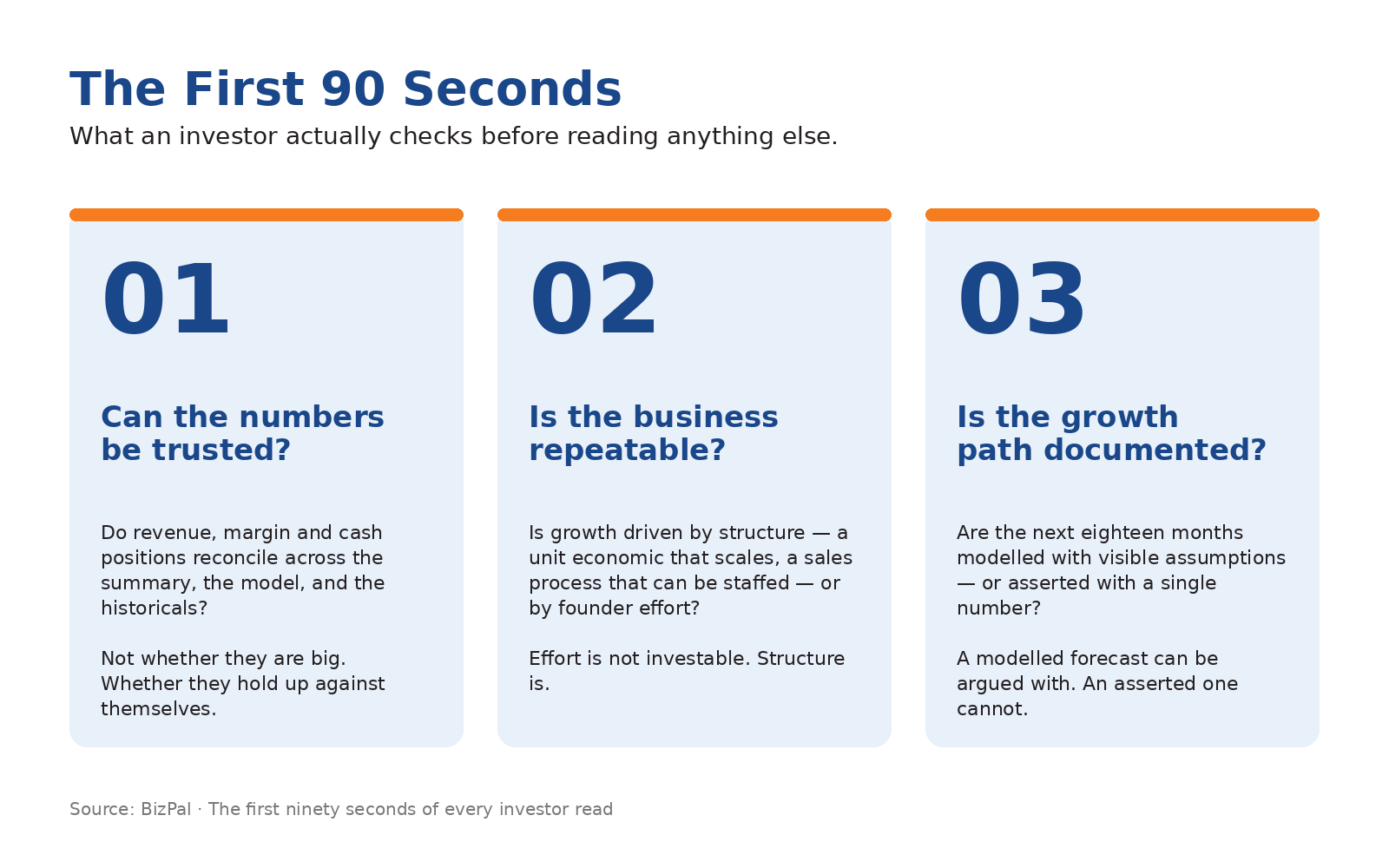
Check one: can the numbers be trusted? The investor looks for whether the revenue, margin, and cash positions reconcile across the financial summary, the model, and the historical statements. Not whether they are big. Whether they hold up against themselves. A founder cannot fake this in a deck; it is either consistent or it is not. Inconsistency is the fastest no in the room.
Check two: is the business repeatable? The investor looks for whether the growth is driven by something structural — a unit economic that scales, a sales process that can be staffed — or by founder effort. Effort is not investable. Structure is.
Check three: is the growth path documented? The investor looks for whether the next eighteen months are modelled with visible assumptions, or asserted with a single number. A modelled forecast can be argued with, refined, stress-tested. An asserted one cannot be evaluated at all — and what cannot be evaluated cannot be funded.
None of these checks are about the quality of the business. They are about the quality of the data describing the business. A great company with check-one failures gets declined. A more modest company with all three checks passing gets a meeting. The investor is not being lazy in running these checks first; they are doing the only thing the available information allows. The founder's job is to make sure the information allows more.
A common objection at this point is that the business is too small, too early, or too informal for any of this to matter yet. The opposite is true. A small business with clean reconciled numbers and a documented eighteen-month model is more capital-ready than a much larger business whose numbers do not tie out and whose growth is described in adjectives. Size is not the qualifier. Structure is. A founder running a five-person business who can answer the three checks above is, in a meaningful sense, more fundable than a founder running a fifty-person business who cannot.
What This Changes for the SME Owner
If capital follows structured data, the fundraising sequence inverts.
The work begins long before the first investor conversation, not after it. It begins with the Data Room — and the SME owner's job, before pitching anyone, is to make sure the three checks above pass cleanly. That is not a fundraising activity. It is a business activity. It happens to be the one that makes fundraising possible.
This inversion is the part most founders find hardest to accept. The instinct is to wait — to wait until revenue is higher, until the team is bigger, until the moment feels right — and only then begin the work of structuring. By then it is too late. The data has accumulated unstructured for years and the work of cleaning it costs ten times what it would have cost to build it correctly the first time. The companies that move fastest at fundraising are the ones who treated structuring as a habit, not a project. They were ready before they needed to be ready.
The companies that raise quickly, at better terms, from better investors are not the businesses that found the right network or refined the perfect pitch. They are the ones who built the data foundation early — before they needed it, while there was time to do it properly — and walked into the room with a story the investor could verify without effort.
That is what capital readiness is built, not found actually means. And it is why, at BizPal, the conversation does not start with how to raise. It starts with whether the data is ready to be raised against.