Investors do not read the pitch deck first. They open the data room. Here is what they expect to find inside, and what a business your size can skip.
Most businesses think the pitch deck is the test. Investors think the Data Room is.
The deck gets weeks of attention. The story gets rehearsed. The first meeting goes well, because first meetings usually do. Then the follow-up email arrives, and it does not ask for a second meeting. It asks for access to the data room. That request is the real beginning of the process, and for most SMEs it is also where the process quietly ends.
A Data Room is the set of documents that lets an outsider verify what you have told them about your business, without needing you in the room to explain it. That is the whole definition. It is not a legal formality and it is not a large-company ritual. It is the difference between a claim and a fact.
Why do investors ask for a data room before they ask about the business?
Because a conversation cannot be audited. An investor who has sat through the pitch now holds a set of statements: revenue is growing, margins are healthy, the customer base is loyal, the company is clean. Every one of those statements is a claim until a document supports it. The data room is where claims become facts, or fail to.
This is why the request comes so early. Investors are not being difficult. They are managing their own time. A fund that reviews a hundred businesses a year cannot afford to spend three weeks on one whose numbers turn out not to reconcile. So the data room request is a filter, and it is applied before serious attention is spent. The business that answers it in two days keeps the investor's attention. The business that needs six weeks to assemble it usually finds the attention has moved on.
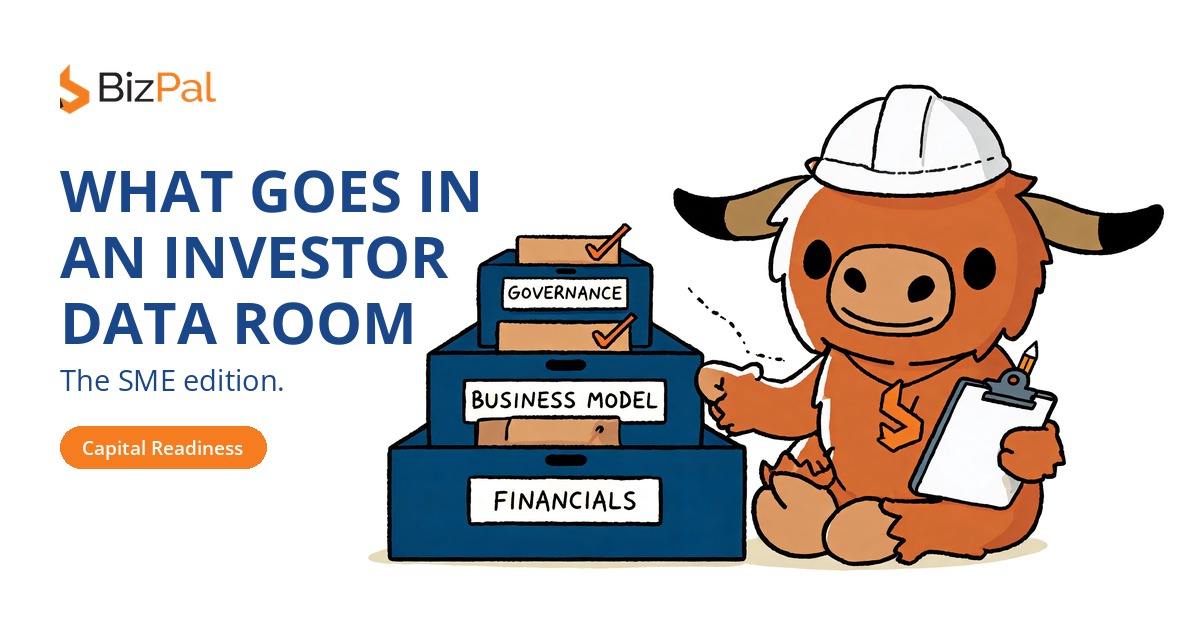
Here is the direct answer to the question most owners arrive with. An investor data room for an SME has three layers. The first is verified financial data, which answers the question "can I trust the numbers?" The second is a structured business model, which answers "is this repeatable?" The third is a governance foundation, which answers "can this company hold outside money?" Every document an investor will ever request from you falls into one of those three. If you can answer all three questions with documents, you have a Data Room. If you can only answer them in a meeting, you do not, whatever the folder on your server is called.
97% of SMEs fail at fundraising. Very few of them fail because the business was bad. They fail because the evidence could not be produced fast enough, in a form a stranger could check, while the investor was still paying attention.
Why do good businesses get this wrong?
The usual assumption is that the data room is paperwork: a due-diligence chore that gets done once someone serious shows interest. Under that assumption, the sensible move is to wait. Why spend time assembling documents for an investor who may never appear?
The assumption is wrong in a way that costs businesses money. The data room is not paperwork about the business. It is the business, made visible to someone who was not there when it was built. Investors do not need a story they have to believe. They need a picture they can check. A founder who can only tell the story has to be present for every conversation, and has to be trusted in every one. A founder who can hand over the picture can be verified once and then discussed on the merits.
There is a second consequence, and it matters more than the first. The three questions an investor asks, about trust, repeatability and structure, are the same three questions an owner should be able to answer every month, whether or not anyone is raising. A business that can produce reconciled accounts, revenue by product and an up-to-date cap table on demand is not just fundable. It is being run from evidence rather than instinct. The Data Room is the by-product of a business that understands itself. Building it is not preparation for investors. It is preparation for running the company properly, and investors are simply the first people to check.
That is the shift. You do not assemble a data room when an investor asks. You build the structure first, and the data room is what the structure looks like from the outside.
Investors do not need a story they have to believe. They need a picture they can check.
What are the three layers of an investor data room?
Most data-room guides are written for venture-backed technology companies with a finance team and a lawyer on retainer. This is not that. What follows is what a RM5M family-run manufacturer, distributor or service business actually needs, layer by layer, with the most common gap named for each.
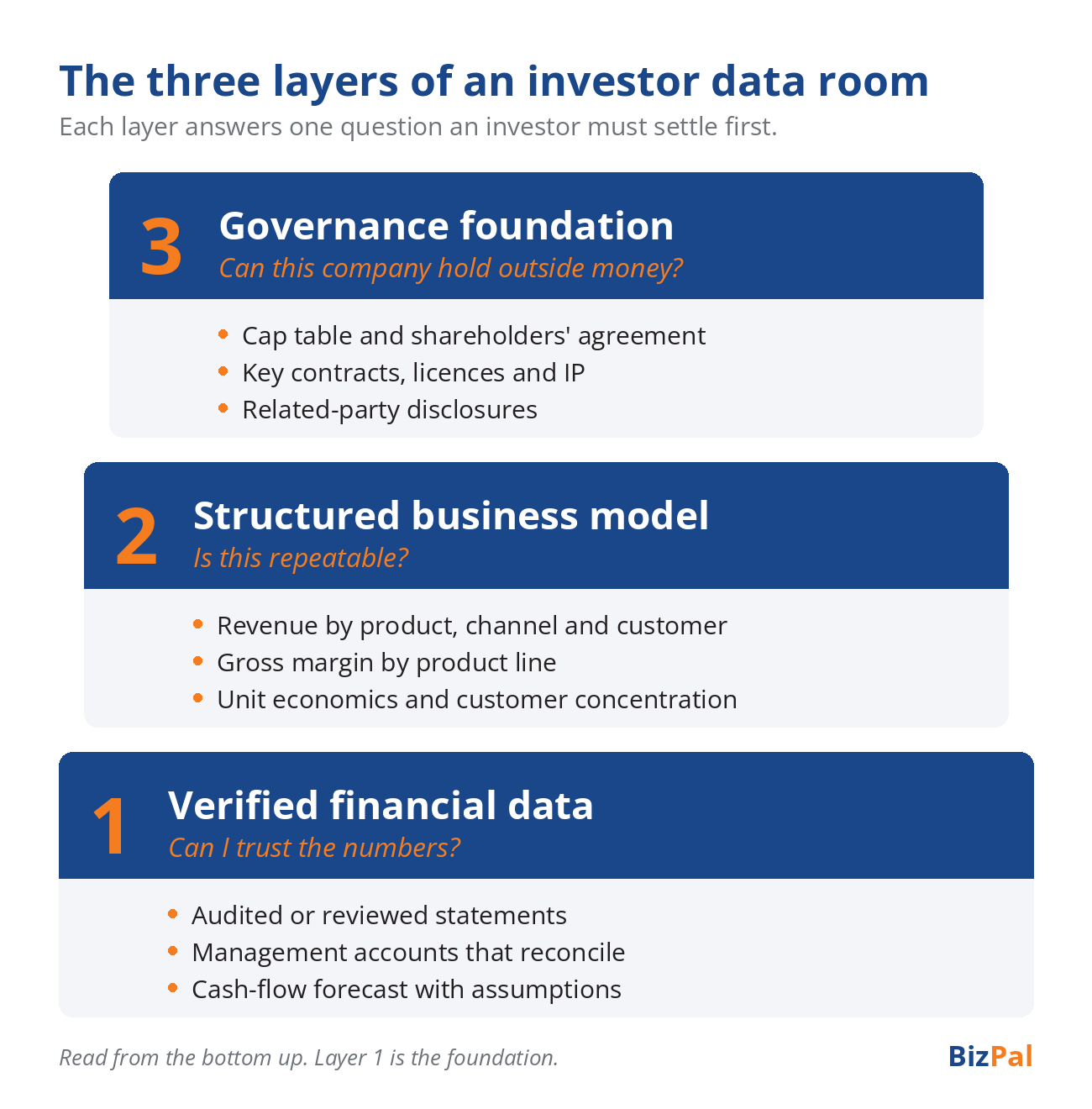
Layer 1: Verified financial data
The investor's first question is whether the numbers can be trusted, and the word that matters is verified. Verified does not mean audited, though an audit helps. It means that every figure you have quoted can be traced to a document that someone else prepared or that a bank produced.
In practice, for an SME, this layer holds the last three years of audited or independently reviewed financial statements, the monthly management accounts for the same period, twelve months of bank statements, the aged receivables and payables ledgers, the tax filings, and a cash-flow forecast covering the next twelve to twenty-four months with its assumptions written down.
If you have no audit, do not treat that as disqualifying. A set of management accounts that reconciles cleanly to bank statements and tax filings is more persuasive than an audit report that contradicts the figures in your deck.
The most common gap in this layer is exactly that contradiction. Management accounts prepared for running the business and audited accounts prepared for the tax authority tell different stories, and nobody has ever reconciled them. The investor finds the difference in the first hour, and from that moment every other number in the room is treated as unverified. If the profit in your deck and the profit in your audited statements are not the same figure, or you cannot explain the bridge between them in one page, that page is the first thing to build. The forecast is the second. An investor reads a cash-flow forecast to learn how you think, not to learn the future, so the assumptions matter more than the totals.
Layer 2: Structured business model
The second question is whether the results are repeatable, and it cannot be answered with a total. Revenue of RM6M tells an investor nothing about whether next year's RM6M will arrive. Revenue of RM6M broken down by product, channel and customer tells them almost everything.
This layer holds the revenue analysis: by product line, by sales channel, and by customer, with the top ten customers named and their share of revenue shown. It holds gross margin by product line, so the investor can see which products make money and which merely make volume. It holds the unit economics in whatever form fits the business: cost to acquire a customer and cost to serve one for a service business, cost per unit and contribution margin for a manufacturer. It holds the pricing logic, the supplier dependencies, and the growth plan expressed in the numbers that drive it rather than in adjectives.
The most common gap here is that revenue exists only in total. The owner knows, from memory, which products and customers matter. The accounting system has never been asked to show it. This is the layer that surprises owners most, because building it usually reveals something about the business that the owner half-knew and had never had to look at directly. That discovery is uncomfortable and it is the point. It is far better to find it yourself than to read it in an investor's memo.
Layer 3: Governance foundation
The third question is whether the company can hold outside money, which is a structural question, not a financial one. An investor who is satisfied with the numbers and the model now needs to know what they would actually be buying, who else owns it, and what obligations come attached.
This layer holds the cap table and the shareholders' agreement, the company constitution, the board and management structure with named roles, every key contract (major customers, major suppliers, property leases, bank facilities), licences, trademarks and any registered IP, a disclosure of related-party transactions, and a statement of any litigation or compliance issues, open or recently closed.
The most common gap in owner-managed businesses is the shareholders' agreement: out of date, unsigned, or never drafted because the shareholders were family and the arrangement was understood rather than written. Related-party transactions are the second gap, usually a director's property leased to the company, or a supplier owned by a relative, neither of which is a problem in itself and both of which become a problem when discovered rather than disclosed. Everything in this layer is inexpensive to fix before a raise and expensive to fix during one, because during a raise it is negotiated rather than simply corrected.
What does a data room look like for a RM6M business?
Consider a food manufacturer in Johor. Revenue of RM6M, profitable, twelve years old, owner-managed, seeking RM1.5M to fund a second production line. The pitch is clean: steady growth, established customers, a clear use of funds.
Layer 1 goes well. Three years of audited statements reconcile to the management accounts within a rounding difference, bank statements support the cash position, and the forecast assumptions are conservative. The investor's first question is answered in a day.
Layer 2 is where the picture changes. The revenue breakdown shows that one hypermarket chain accounts for 41% of sales. The margin analysis shows that the two lowest-margin SKUs make up 30% of volume at a 9% gross margin, while the rest of the range runs above 30%. Neither fact appeared in the deck. Neither is fatal. But they change what the RM1.5M is actually for. A second line that produces more of the 9% SKUs for the same customer is a very different investment from a second line that lets the business diversify.
Because the owner built the layer before the raise, the conversation that follows is about terms, not trust. The investment is structured in two tranches, the second released when concentration falls below 30%, and the owner reprices the two weak SKUs before the first tranche lands. The business raises the money. Now consider the same business without Layer 2. The investor's own analyst builds the breakdown during diligence, the 41% figure appears in a memo written by someone else, and the owner reads about their own concentration risk in a document that frames it as the reason to walk away. Same business, same numbers, different outcome. The only variable was who found the number first.
What should you do with this now?
Take the three questions and answer them honestly, in writing, this week. Can a stranger trust your numbers without you explaining them? Can they see what is repeatable without you pointing at it? Can they see exactly what they would own and what comes attached? For each question, write down the single document that is missing or wrong. Most businesses find one layer that is largely fine, one with a gap, and one that has never been looked at.
Pick the layer with the biggest gap, list what is missing, and give it a date. The Data Room is not the folder you assemble when an investor asks. It is what your business looks like when it can be verified by someone who was not there. Build that first, and the pitch deck becomes what it should always have been: a summary of evidence that already exists.